
Understanding upload LOI Trados is essential for modern commodity traders. # What Happens When You Upload an LOI to Trados
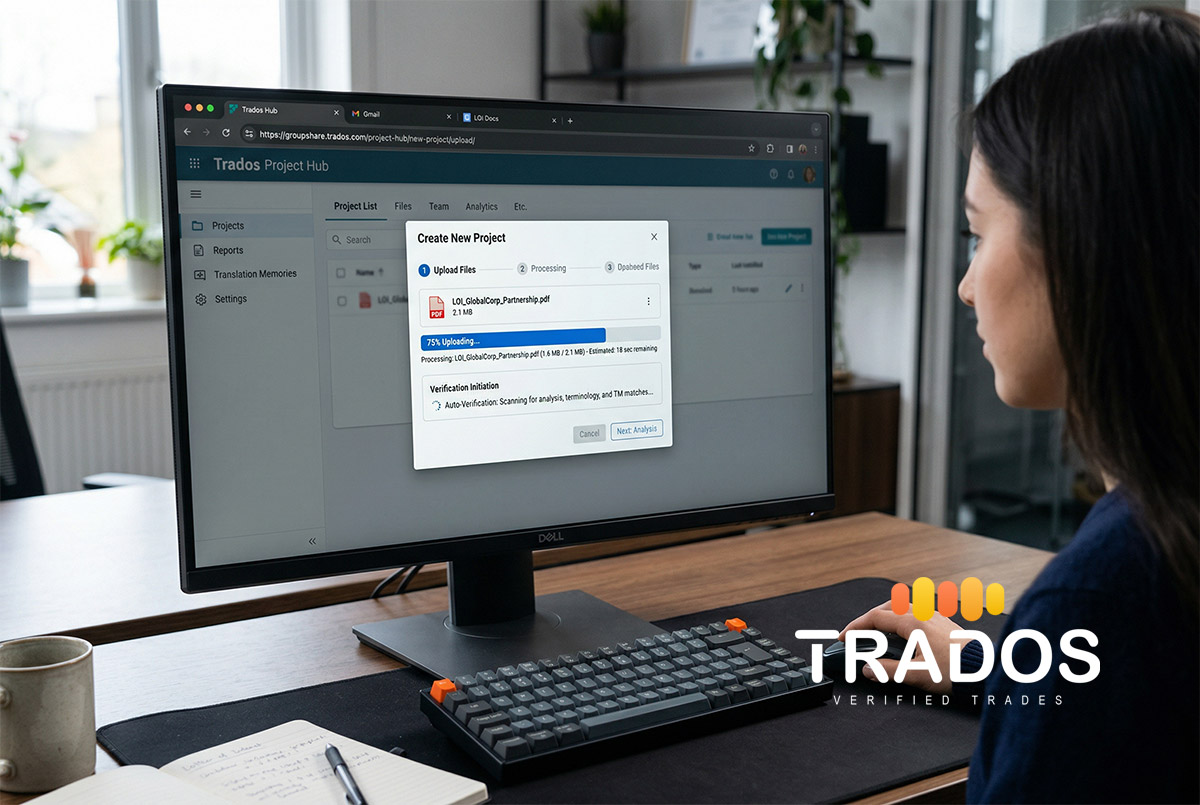
Uploading your first Letter of Intent (LOI) to Trados feels like sending a message into the void. You click submit, see a loading spinner, and then—what? Does a human review it? Is it checked against a database? How long until you know if everything is valid?
Most trading platforms treat this process like a black box. You submit documents and hope for the best. Trados takes a different approach: complete transparency into what happens at every stage. Understanding this process does not just reduce anxiety—it helps you submit better documents and catch issues before they become problems. Experienced professionals in upload LOI Trados consistently emphasize this point.
Here is exactly what happens from the moment you click upload to the moment your LOI receives certification status.
Stage 1: Document Ingestion (0-30 Seconds)
The moment you drop your LOI into Trados, the system begins a three-layer intake process designed to catch problems immediately.
Format Verification
First, Trados checks that your file meets basic requirements. The system accepts PDFs, scanned images (JPEG, PNG), and Word documents. If you upload something else—a PowerPoint presentation or an Excel sheet—you will get an instant rejection with a clear message: “Unsupported file format. Please upload PDF, JPEG, PNG, or DOCX.”
This saves everyone time. No one reviews a file that cannot be processed. When evaluating upload LOI Trados, this factor plays a significant role.
File Integrity Check
Next, the system verifies that the file is not corrupted. A damaged PDF or incomplete upload gets flagged immediately. You will see: “File appears corrupted. Please check your upload and try again.”
This step matters because corrupted documents are surprisingly common in trading. Spotty internet connections, email forwarding chains, and scanner malfunctions all create files that look fine but contain errors. Catching this upfront prevents the frustration of waiting for review, only to find out the document was unreadable.
Metadata Extraction
Finally, Trados extracts basic information from your document: file name (preserved for your reference), upload timestamp (automatically recorded in UTC), file size (flagged if unusually large or small), and page count (verified against expected LOI length). This is a critical aspect of upload LOI Trados that every trader should understand.
If your LOI is 47 pages, the system flags it for manual review—most LOIs are 1-3 pages. This is not a rejection; it is a checkpoint to ensure nothing unusual is happening.
What you see: A progress bar showing “Uploading…” followed by “Processing…”
What happens behind the scenes: Format validation, corruption checks, and metadata extraction running in parallel.
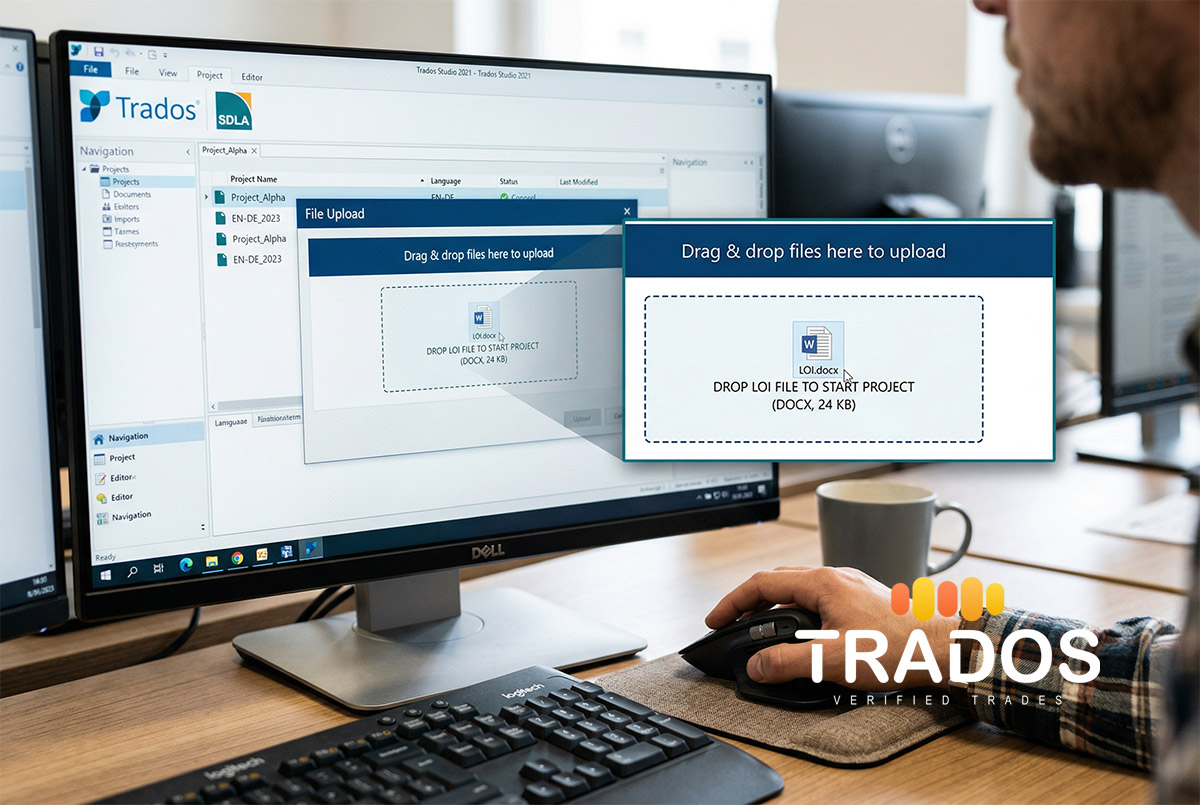
Stage 2: OCR and Text Extraction (30-60 Seconds): Upload LOI Trados Essentials
Once the file passes basic checks, Trados extracts the actual content. This is where the real analysis begins.
Optical Character Recognition (OCR) This best practice for upload LOI Trados has been validated across leading trading firms.
For scanned documents or image-based PDFs, Trados runs OCR to convert visual text into machine-readable data. The system uses advanced OCR engines trained specifically on trade documents, recognizing industry-specific terminology like “FAS,” “FOB,” “ICUMSA,” and “polarization.”
Standard OCR tools struggle with trade documents. They misread “mt” (metric tons) as “m1” or confuse “ICUMSA” with random characters. Trados’s OCR has been refined on thousands of commodity trading documents, achieving 98.7% accuracy on standard LOI formats.
Text Normalization
After extraction, the system normalizes the text. Dates are converted to ISO format (YYYY-MM-DD) regardless of how they were written. Numbers are standardized (commas, periods, spaces removed for consistent processing). Units are normalized (“MT,” “mt,” “metric tons,” and “tonnes” all become standard units). Currency indicators are extracted and standardized.
This normalization ensures that “10,000 MT” and “10000 metric tons” are recognized as identical quantities, even if written differently. Top trading firms leverage this insight as part of their upload LOI Trados approach.
Structure Analysis
Finally, Trados maps the document structure. LOIs follow predictable patterns, and the system identifies header information (date, reference numbers, parties), product specifications (type, quality, quantity), commercial terms (price, delivery, payment), and signatures and authorization (who signed, their role).
What you see: The status changes to “Analyzing document…”
What happens behind the scenes: OCR processing, text normalization, and structural analysis creating a machine-readable version of your LOI.
Stage 3: Data Extraction and Field Mapping (60-120 Seconds)
Now the system extracts specific data points and maps them to Trados’s internal fields. Getting this right is fundamental to any successful upload LOI Trados strategy.
Key Field Extraction
Trados extracts 23 standard fields from every LOI: buyer name, seller name, product, quantity, origin, destination, price, delivery period, payment terms, signatory name, signatory title, and 12 additional fields. Each field is extracted and confidence-scored. A perfectly clear typed document might score 99% confidence. A faxed scan with handwritten notes might score 85%. Anything below 70% confidence gets flagged for manual review.
Cross-Reference Validation
Extracted data is cross-referenced against existing records. Buyer and seller names are matched against the counterparty database. Product specifications are checked against standard commodity definitions. Quantities are validated against typical shipment sizes (spotting a 500,000 MT sugar order triggers a warning). Delivery periods are checked for seasonality issues.
If the system finds a discrepancy—say, a buyer name that does not match any registered counterparty—it flags the field rather than rejecting the document. This gives you the opportunity to confirm or correct the information. The relationship between this and upload LOI Trados is well-documented in the industry.
Document Classification
Trados classifies the LOI type based on content: standard spot purchase (single shipment, fixed price), contract purchase (multiple shipments over time), optional/tender (conditional on acceptance), or framework agreement (terms for future deals). This classification determines which validation rules apply and what next steps are suggested.
What you see: “Extracting data…” with a percentage indicator
What happens behind the scenes: 23 fields extracted, confidence-scored, cross-referenced, and classified.

Stage 4: Verification and Validation (120-180 Seconds)
This is the critical stage where Trados verifies that the LOI is legitimate and complete. For firms focused on upload LOI Trados, this should be a top priority.
Completeness Check
The system verifies that all required fields are present. Mandatory fields include buyer, seller, product, quantity, price, delivery, and signatures. Recommended fields include reference numbers, inspection terms, and force majeure clauses. Optional fields include broker details, specific vessel requirements, and insurance terms.
Missing mandatory fields trigger a “Needs Information” status with specific requests: “Please provide signatory title” or “Delivery port not specified.”
Logical Consistency
Trados checks that the document makes logical sense. Price vs. product alignment flags ICUMSA 45 at $200/MT (well below market). Quantity vs. vessel size flags 5,000 MT in a Panamax vessel for efficiency concerns. Origin vs. destination compatibility flags Brazilian sugar to a landlocked destination without transit port. Delivery timing flags past-dated delivery periods as potentially expired. Industry experts agree that upload LOI Trados effectiveness depends heavily on this factor.
These are not automatic rejections. They are warnings: “Price appears significantly below current market. Please confirm.”
Duplicate Detection
The system checks for potential duplicates: exact matches (identical content to previously uploaded LOI), near matches (same parties, product, and quantity with minor differences), and reference number conflicts (same reference number from same issuer on different documents).
Duplicate detection prevents the common problem of the same LOI being uploaded by both buyer and seller, creating two separate deal records.
Counterparty Verification This principle applies broadly across all aspects of upload LOI Trados in commodity markets.
If both parties are registered Trados users, the system verifies both accounts are active and in good standing, checks transaction history between the parties, validates signatory authority against authorized representative lists, and flags new relationships for enhanced attention.
For unregistered parties, the system notes this and suggests inviting them to verify their identity.
What you see: “Verifying document…” with occasional clarification requests
What happens behind the scenes: Completeness, logic, duplicate, and counterparty checks running in parallel.
Stage 5: Certification Decision (180-240 Seconds)
All the analysis culminates in a certification decision. Understanding this connection to upload LOI Trados gives traders a measurable advantage.
Auto-Certification Criteria
LOIs that meet all these criteria receive immediate auto-certification: all mandatory fields present with >90% confidence, no logical inconsistencies flagged, both parties verified Trados users, no duplicates detected, document format standard and complete, and price within reasonable market range.
Approximately 67% of LOIs qualify for auto-certification, meaning most users get instant results.
Manual Review Triggers
LOIs are routed to manual review if confidence score falls below 70% on any mandatory field, logical inconsistencies are flagged, mandatory information is missing, one or both parties are unverified, duplicates are detected, or document format is non-standard.
Manual review typically takes 2-4 hours during business hours, 24 hours maximum.
Certification Levels
Trados assigns one of four certification levels. Certified (Green) means the document passed all automated checks and/or manual review. All data verified, parties confirmed, terms standardized. This LOI can proceed to ICPO with confidence.
Conditionally Certified (Yellow) means the document is valid but has flagged items requiring attention. Examples include price outside market range, signatory not in authorized list, or recommended fields missing. The LOI is usable but marked for review.
Pending Information (Orange) means the document is incomplete or unclear. Specific requests issued for missing data.
Related Articles
Learn more about WTO trade regulations.



Solid insights as always.
One of the best articles I’ve read on this.
I remember when we used to verify everything by phone and fax. The fact that we can now do this digitally in minutes rather than days is transformative.
Shared this with my entire team.
This should be required reading.
This is the kind of content that actually moves the industry forward. No fluff, just actionable information that traders can use immediately.