

In this guide, we explore LOI templates killing deals and its impact on your trading operations. # LOI Templates Are Killing Your Deals
That LOI template you downloaded from a legal website? It’s costing you deals. Not might cost you—already is. In commodities trading, where a single sugar or grain transaction can run into seven figures, generic templates create more problems than they solve. The copy-paste approach to Letters of Intent isn’t just lazy; it’s a liability that exposes your operation to counterparty disputes, regulatory scrutiny, and failed negotiations.
The hard truth: most LOI templates weren’t written for commodities trading. They were written for general business transactions—mergers, real estate, service agreements. Jamming your sugar export deal or grain purchase into a one-size-fits-all document is like wearing dress shoes to a construction site. It looks professional until you actually need to move. The relationship between this and LOI templates killing deals is well-documented in the industry.
Why Do Generic LOIs Actually Fail?
Generic LOI templates fail for three specific reasons that matter in commodities trading: imprecise specifications, missing protective clauses, and outdated structures that signal amateurism to experienced counterparties.
Imprecise Specifications Kill Deals For firms focused on LOI templates killing deals, this should be a top priority.
A standard template might include a line like “Seller agrees to supply commodities as specified in Schedule A.” That sentence is worthless in a sugar deal where moisture content, polarization, and ICUMSA ratings determine price.
A Brazilian sugar exporter needs precise specification language: ICUMSA 45, polarization minimum 99.80%, moisture maximum 0.05%, delivered in 50kg polypropylene bags, containerized 26 tons per 20-foot unit. Generic templates leave these details blank or use placeholder text. Experienced traders see this immediately. It signals one of two things: you don’t know what you’re buying, or you don’t care enough to specify. Either way, you’ve just lost leverage in negotiation. The counterparty knows they can push on terms because your documentation is loose. Industry experts agree that LOI templates killing deals effectiveness depends heavily on this factor.
Missing Protective Clauses Create Exposure
Commodities trading has unique risks that generic templates ignore. Where is your force majeure clause that specifically covers port closures, harvest failures, or export license delays? How do you handle quality disputes—does your template include SGS or Intertek inspection protocols? What about the 2% tolerance on quantity that buyers expect but sellers resist? This principle applies broadly across all aspects of LOI templates killing deals in commodity markets.
A grain trader in Santos recently learned this the hard way. He used a downloaded LOI template for a 25,000 MT corn purchase. The document lacked specific delivery windows, stating only “delivery within Q2.” When the seller attempted delivery during the last week of June—technically within Q2—the buyer’s storage facility was at capacity. The dispute cost three weeks, legal fees, and ultimately the relationship with a key supplier. A proper commodities LOI would have specified delivery windows by month or even by week.
Outdated Structures Signal Weakness Understanding this connection to LOI templates killing deals gives traders a measurable advantage.
The LOI format matters. Experienced commodity traders recognize template language instantly. Phrases like “the parties hereto” and “whereas, the buyer desires” mark your document as boilerplate. Modern commodities LOIs are lean, specific, and action-oriented. They read like commercial instruments, not legal exercises.
When a Rotterdam grain trader receives an LOI that looks like it came from a 1998 merger agreement, she makes assumptions. She assumes the sender lacks commodities experience. She assumes negotiation will be painful and slow. She may still do the deal, but she’s already calculating a risk premium into her pricing. This directly impacts how LOI templates killing deals performs in real-world trading scenarios.
What Do Bad Templates Actually Cost?: LOI Templates Killing Deals Essentials
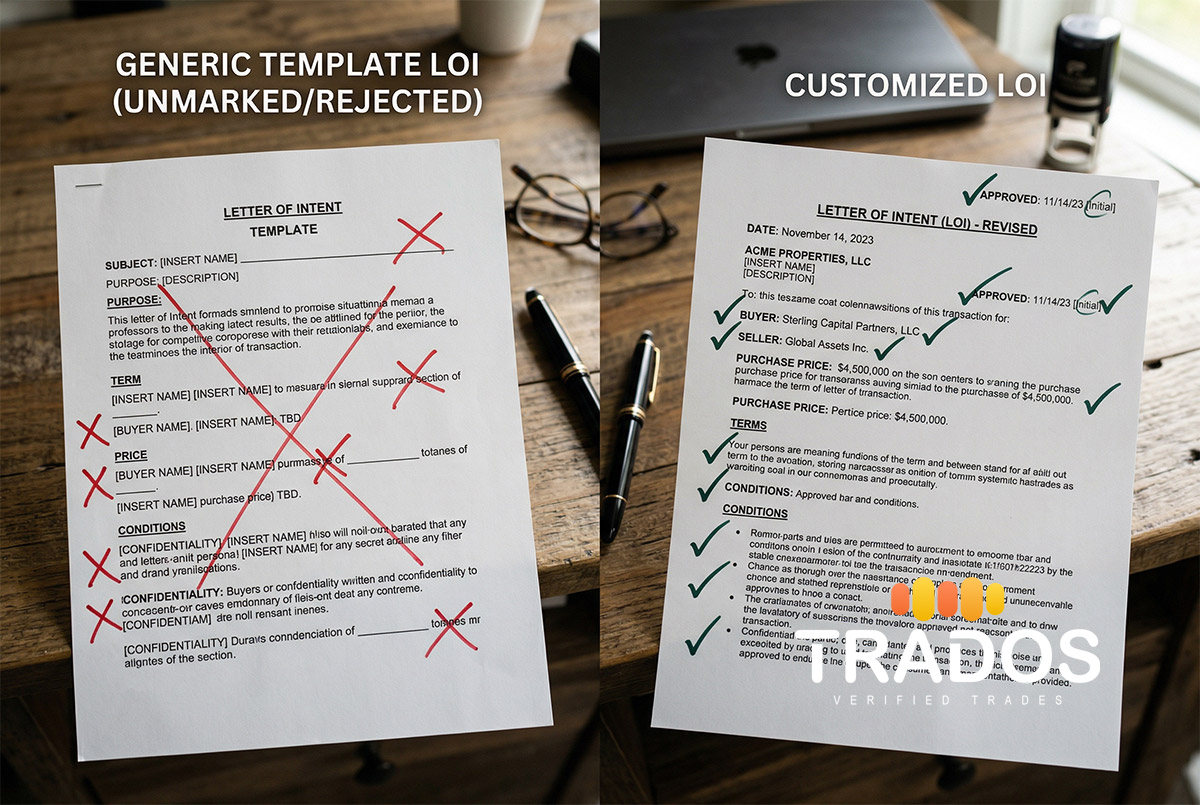
The damage from generic templates isn’t theoretical. Trading firms using downloaded LOIs report longer negotiation cycles, higher legal review costs, and increased deal failure rates. One Brazilian sugar trading house tracked their LOI-to-close rate: deals initiated with custom LOIs closed at 68%, while template-initiated deals closed at 41%. The difference? Nearly three months of wasted time per failed transaction.
Legal review costs compound the problem. A template LOI requires extensive redrafting by commodities lawyers who must essentially rewrite the document. This adds $3,000-$8,000 per transaction in legal fees and one to two weeks of delay. A purpose-built LOI, by contrast, needs only review and minor adjustment—typically under $1,000 and completed in 48 hours. Experienced professionals in LOI templates killing deals consistently emphasize this point.
The reputational cost is harder to quantify but equally real. Counterparties talk. A trading firm known for sloppy documentation finds doors closed. When a major grain aggregator in Chicago sees your company name on an LOI, you want them thinking “professional operator,” not “amateur with a Google template.”
What Actually Works?
After reviewing thousands of commodities transactions and documenting hundreds of LOI failures, we’ve developed a different approach. The Trados LOI framework abandons templates in favor of structured, verified documentation that adapts to each trade while maintaining consistency and protection. When evaluating LOI templates killing deals, this factor plays a significant role.
Dynamic Specification Fields
Instead of blank spaces or generic placeholders, Trados LOIs use dynamic fields populated from verified commodity databases. When you initiate a sugar deal, the system pre-fills ICUMSA standards, polarization ranges, and packaging specifications appropriate to your trade lane. These aren’t suggestions—they’re validated against industry standards and previous successful transactions. This is a critical aspect of LOI templates killing deals that every trader should understand.
The key difference: every specification is traceable. When you specify “ICUMSA 45,” the LOI includes the testing methodology, acceptable variance, and dispute resolution protocol. No ambiguity. No room for interpretation that favors one party over another.
Embedded Risk Management This best practice for LOI templates killing deals has been validated across leading trading firms.
Trados LOIs incorporate protective clauses as standard features, not afterthoughts. Force majeure language specific to agricultural commodities. Quality inspection protocols with agreed third-party inspectors. Delivery windows that account for seasonal port congestion. Payment terms structured around document presentation and vessel loading, not arbitrary calendar dates.
These clauses aren’t static. They evolve based on market conditions, regulatory changes, and lessons from completed transactions. When a new export regulation affects Brazilian sugar, the LOI framework updates automatically. Users don’t need to know the law changed—their documentation reflects it. Top trading firms leverage this insight as part of their LOI templates killing deals approach.
Counterparty Verification Integration
Here’s where the approach diverges fundamentally from templates. Trados LOIs are issued through a verification system that confirms counterparty identity, authority to bind, and financial capacity before the document is even generated. When you receive a Trados LOI, you know the issuer has been verified. When you issue one, your counterparty knows the same. Getting this right is fundamental to any successful LOI templates killing deals strategy.
This changes negotiations. Verification eliminates the “who are these guys?” phase that consumes the first week of most commodity deals. It allows immediate focus on terms, pricing, and logistics—the elements that actually determine transaction success.

Template vs. Verified: A Real Comparison
Consider two approaches to the same transaction: a 12,500 MT white sugar purchase from Santos to Jebel Ali.
Template Approach:
– Generic LOI downloaded from legal website
– Specifications: “white sugar, standard export quality”
– Delivery: “within 60 days of contract date”
– Payment: “by wire transfer upon delivery”
– Outcome: Three rounds of revision, two weeks of delay, disputed quality standards, deal closed at worse terms due to negotiation fatigue
Verified Trados Approach:
– System-generated LOI with pre-validated specifications
– Specifications: “White refined sugar ICUMSA 45, polarization 99.80° min, moisture 0.05% max, packed in new 50kg polypropylene bags, 26 MT per 20′ container”
– Delivery: “Shipment during March 2025, loading window March 1-15 as per vessel nomination”
– Payment: “Irrevocable Letter of Credit payable 100% at sight against presentation of shipping documents”
– Outcome: Single revision round, five-day execution, clear quality protocols, deal closed at target terms
The difference isn’t minor optimization. It’s the gap between amateur and professional execution.
When Might Templates Actually Work?
Templates have a place in commodity trading, but it’s narrow. If you’re executing the same transaction repeatedly—same counterparty, same specifications, same terms—a standardized LOI makes sense. But this isn’t a downloaded template. It’s a custom document developed for your specific recurring trade, reviewed by commodities counsel, and refined through actual transaction experience.
For spot transactions, new counterparties, or any deal involving specification variation, generic templates fail. The cost of customization exceeds the cost of building proper documentation from the start. More importantly, the risk of oversight—missing a critical clause, using incorrect specification language, creating ambiguity that favors your counterparty—outweighs any time saved by copy-paste.
How Do You Move Beyond Templates?
The path forward requires abandoning the template mindset entirely. Commodities trading demands documentation that reflects the complexity, risks, and regulatory environment of actual transactions. This means either investing in custom LOI development or adopting systems that generate transaction-appropriate documentation automatically.
For firms executing regular volume, the investment in proper LOI frameworks pays for itself in reduced legal costs, faster deal cycles, and improved close rates. A trading house completing 50 transactions annually saves approximately $150,000 in legal review costs alone by using structured, pre-approved documentation instead of template-and-revise approaches.
The alternative—continuing with generic templates—means accepting higher failure rates, longer negotiations, and the quiet reputational damage of being known as the firm that doesn’t know how to document a trade properly. Professional documentation reflects professional operations—and the market remembers both.
Related Articles
Learn more about UNCTAD commodity reports.



What’s the cost comparison between building an in-house verification system vs using a platform like Trados?
Can you elaborate on the digital signature verification part? We’ve been using a manual process and I’m not sure how to transition.