

The Compliance Landscape
Understanding commodity trade compliance is essential for modern commodity traders. International commodity trading operates in a complex web of regulations. From export controls to anti-money laundering (AML) rules, compliance isn’t optional — it’s survival.
Key Regulatory Frameworks: Commodity Trade Compliance Essentials
1. Export Controls
OFAC (US Office of Foreign Assets Control):
– Sanctions against specific countries
– Prohibited party lists (SDN List)
– Sectoral sanctions
EU Dual-Use Regulations:
– Export licensing requirements
– End-use monitoring
– Documentation standards This best practice for commodity trade compliance has been validated across leading trading firms.
BIS Export Administration Regulations (US):
– Commodity classifications (ECCN)
– License requirements
– Record-keeping obligations
2. Anti-Money Laundering (AML)
Know Your Customer (KYC):
– Identity verification
– Beneficial ownership disclosure
– Source of funds verification
– Ongoing monitoring
Suspicious Activity Reporting (SAR):
– Unusual transaction patterns
– Red flag identification
– Regulatory filing requirements
3. Anti-Corruption
FCPA (Foreign Corrupt Practices Act – US):
– Prohibition on bribing foreign officials
– Accounting transparency requirements
– Penalties up to $2M per violation
UK Bribery Act:
– Broader scope than FCPA
– Strict liability for failure to prevent
– Penalties up to 10% of global turnover
Documentation Requirements
Essential Documents
For Exporters:
– Commercial invoice
– Packing list
– Bill of lading (B/L)
– Certificate of origin
– Export license (if required)
– Inspection certificates
For Importers:
– Import license (if required)
– Customs declarations
– Duty payment records
– End-use certificates
For All Parties:
– Contracts (LOI, ICPO, SPA)
– Insurance certificates
– Banking documents (LC, BG)
– Compliance certifications Top trading firms leverage this insight as part of their commodity trade compliance approach.
Common Compliance Pitfalls
1. Incomplete KYC
Problem: Insufficient customer due diligence
Consequence: Regulatory penalties, frozen accounts
Solution: Tiered verification (Bronze/Silver/Gold)
2. Sanctions Violations
Problem: Trading with prohibited parties/countries
Consequence: Criminal charges, massive fines
Solution: Real-time sanctions screening
3. Documentation Gaps
Problem: Missing or incomplete paperwork
Consequence: Shipment delays, customs seizures
Solution: Structured document workflows
4. Record-Keeping Failures
Problem: Inadequate transaction records
Consequence: Regulatory audit failures
Solution: Automated audit trails
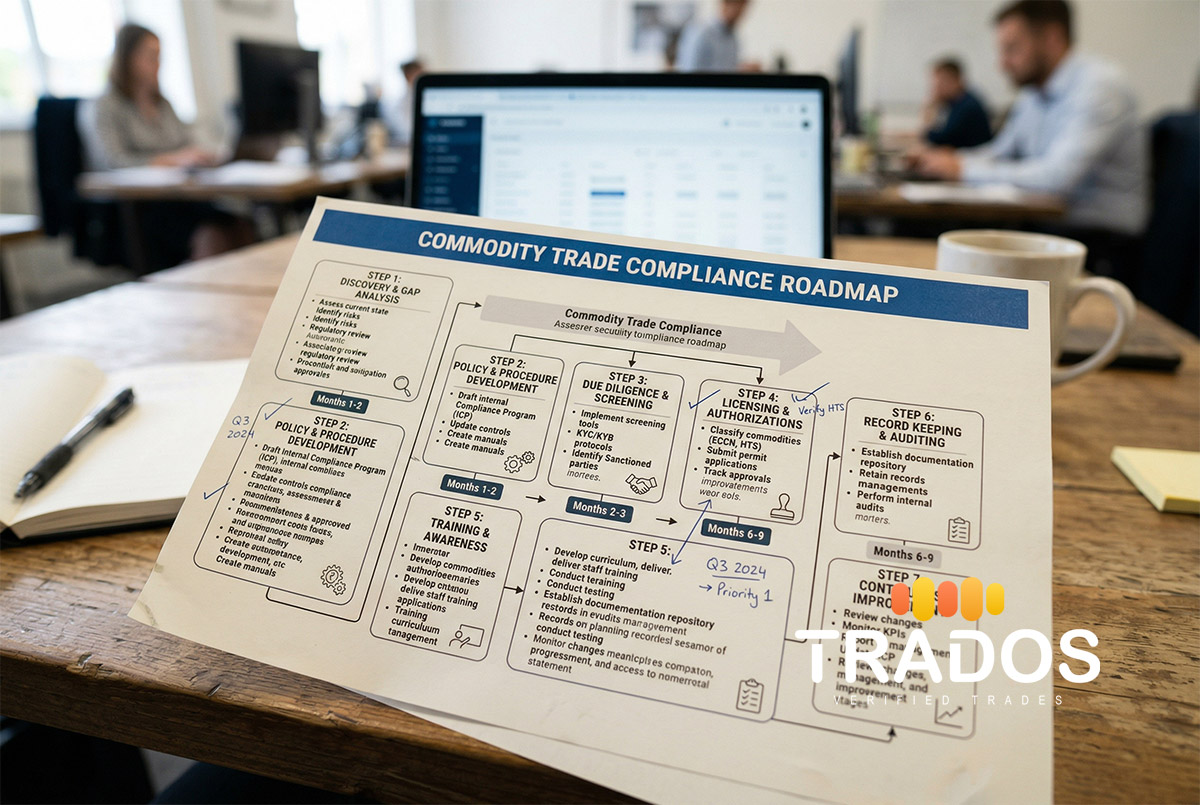
The Trados Compliance Framework
Tiered Verification System
Bronze (Basic):
– Identity verification
– Company registration check
– Initial sanctions screening
Silver (Enhanced):
– Full KYC documentation
– Beneficial ownership verification
– Enhanced sanctions screening
– Bank reference checks
– Trade history review
Gold (Comprehensive):
– On-site verification (where applicable)
– Multiple reference validation
– Continuous monitoring
– Priority compliance support
Automated Compliance Features
Real-Time Screening:
– OFAC/UN/EU sanctions lists
– Prohibited party databases
– Adverse media monitoring
– Politically exposed persons (PEP) Getting this right is fundamental to any successful commodity trade compliance strategy.
Document Management:
– Organized storage
– Version control
– Access logs
– Retention compliance
Audit Trail:
– Every action logged
– Timestamped records
– User attribution
– Immutable history
Regional Compliance Considerations
European Union
– Dual-use export controls: License requirements for sensitive goods
– GDPR: Data protection for customer information
– EU sanctions: Separate from US sanctions
– VAT requirements: Documentation for tax authorities
United States
– EAR (Export Administration Regulations): Technology and software controls
– ITAR: Defense-related articles
– OFAC sanctions: Country-specific restrictions
– FCPA: Anti-corruption enforcement
Asia-Pacific
– China: Import/export licensing
– India: DGFT regulations
– Singapore: TradeFIRST framework
– Australia: Autonomous sanctions
Best Practices for Compliance
1. Develop a Compliance Program
– Written policies and procedures
– Designated compliance officer
– Regular training
– Internal audits
2. Implement Risk-Based Controls
– Customer risk assessment
– Transaction monitoring
– Geographic risk factors
– Product risk evaluation
3. Maintain Documentation
– Keep records for required periods (usually 5+ years)
– Organize for easy retrieval
– Secure sensitive information
– Regular backups The relationship between this and commodity trade compliance is well-documented in the industry.
4. Stay Updated
– Regulatory change monitoring
– Industry association updates
– Legal counsel consultation
– Platform compliance updates
Penalties for Non-Compliance
Financial:
– Fines: $10K to $1B+ depending on violation
– Disgorgement of profits
– Asset seizures
Operational:
– Export privileges revoked
– Banking relationships terminated
– License cancellations
Criminal:
– Individual liability (prison time)
– Corporate criminal charges
– Debarment from government contracts

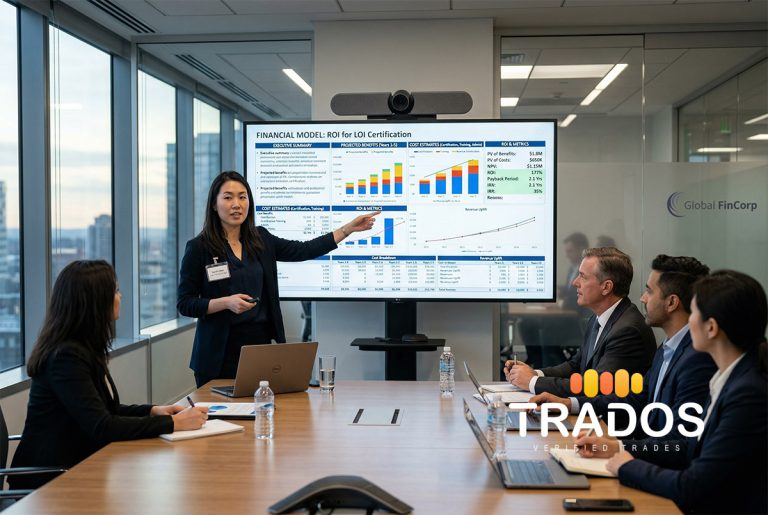
The Cost of Compliance vs. Non-Compliance
Compliance costs:
– Verification: $100-500 per party
– Documentation: $50-200 per transaction
– Platform fees: $500-2,000/month
– Total: ~1-2% of deal value
Non-compliance costs:
– Average FCPA fine: $50M+
– OFAC settlements: $1M-500M+
– Legal defense: $5M+
– Reputational damage: Incalculable
– Total: Potentially company-ending
Building a Compliance Culture
Leadership commitment:
– Tone from the top
– Resource allocation
– Accountability
Employee training:
– Regular compliance updates
– Red flag recognition
– Reporting procedures
Continuous improvement:
– Regular risk assessments
– Policy updates
– Technology upgrades
Technology Solutions
Compliance platforms provide:
– Automated screening
– Document management
– Audit trails
– Regulatory updates
– Risk scoring
– Reporting tools
Get Compliant
Don’t wait for a violation to take compliance seriously.
[Learn About Our Compliance Features →](/services)
Related Articles
Learn more about GAFTA trade standards.


We had a situation last year where a supposedly verified buyer turned out to be operating with forged bank documents. Cost us three months and significant legal fees. Articles like this help prevent that.
As a broker, I initially resisted verification requirements because I thought it would slow down deal flow. It actually accelerated it because both parties have more confidence.
I remember when we used to verify everything by phone and fax. The fact that we can now do this digitally in minutes rather than days is transformative.
Solid piece. My only suggestion would be to address the privacy concerns around sharing company data for verification. It’s a real barrier for some firms.
Much needed perspective on this topic.
Solid insights as always.