


The importance of broker vs real buyer LOI cannot be overstated in modern commodity trading. # How to Spot a Broker vs a Real Buyer in an LOI
In commodity trading, 60% of LOIs never convert to firm contracts. The single biggest reason? You’re negotiating with a broker who has no buyer. They waste your time, burn your credibility with real buyers, and drain resources on deals that were never going to close.
The broker posing as a buyer is the oldest trick in commodity trading. They position themselves between you and the end buyer, hoping to collect a commission without adding real value. By the time you discover the truth, you’ve lost weeks—sometimes months—and your actual buyer has moved on to another supplier. Industry experts agree that broker vs real buyer LOI effectiveness depends heavily on this factor.
This guide gives you practical techniques to identify brokers within 48 hours of receiving an LOI. No guesswork. No hope-based trading. Just systematic verification that protects your time and your deals.
Why the Broker vs. Buyer Distinction Matters
A real buyer has capital allocated, logistics arranged, and authority to commit. A broker has none of these. They have a contact list and a dream.
The distinction matters because the entire deal structure changes based on who you’re talking to. With a real buyer, you negotiate terms directly. With a broker, you’re in a daisy chain—multiple intermediaries between you and the actual decision-maker. Each link weakens the chain. Most daisy chains collapse before delivery. This principle applies broadly across all aspects of broker vs real buyer LOI in commodity markets.
Brazilian sugar exporters lose an estimated $15,000-25,000 in soft costs per failed deal. That includes legal review, document preparation, sample shipping, and opportunity cost. When you multiply that across multiple broker-led deals that go nowhere, the annual waste runs into six figures for active trading desks.
Document Red Flags in the LOI Itself: Broker Vs Real Buyer LOI Essentials
The LOI reveals broker involvement before you ever pick up the phone. Here’s what to look for:
Vague Company Identification. Real buyers use their legal entity name. Brokers use shell companies, trading names, or generic descriptions like “international trading group.” A legitimate buyer’s LOI will include full legal name, registration number, and registered address. Understanding this connection to broker vs real buyer LOI gives traders a measurable advantage.
Run the company name through your local registry immediately. If you cannot verify active status, operating history, or physical premises within 30 minutes, you’re likely dealing with a broker using a paper company.
Missing Banking References. Genuine buyers include bank references or proof of funds documentation. Brokers avoid this because they cannot produce it. They’ll claim “bank confidentiality” or promise to provide proof “once terms are agreed.” This is deflection. Real buyers lead with financial credibility.
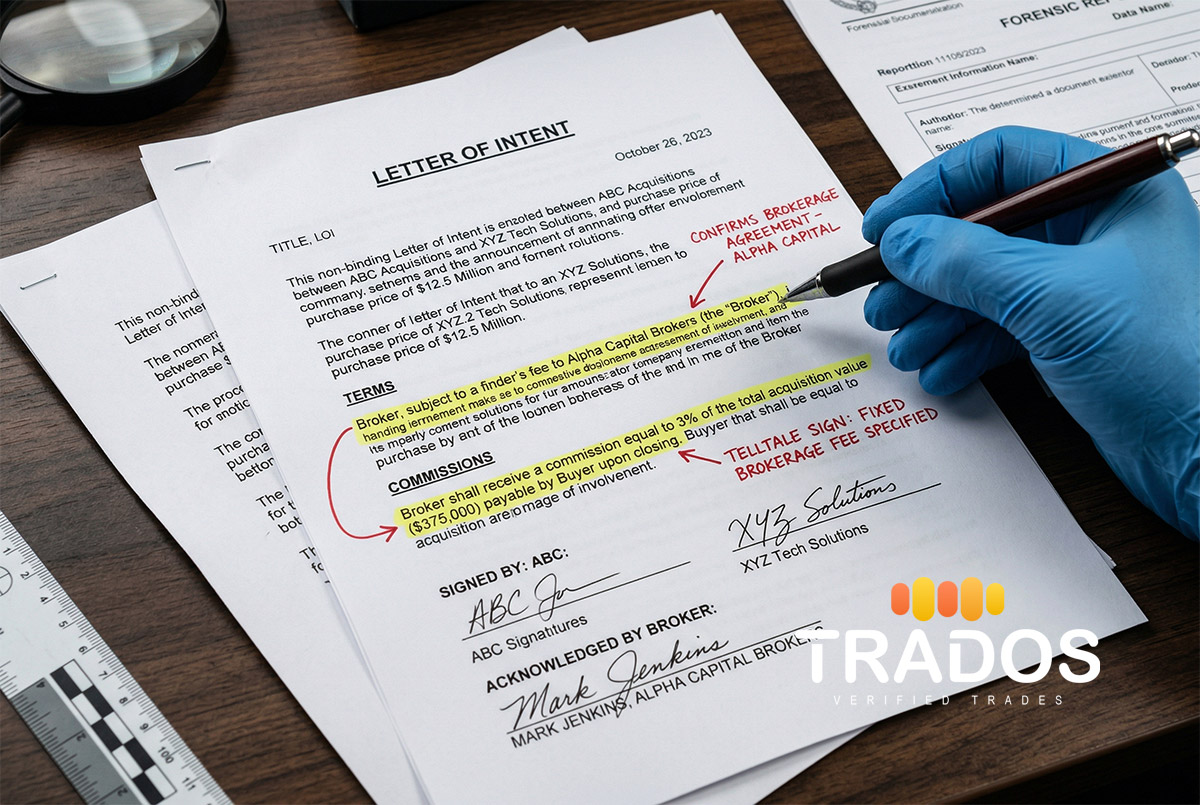
Commission Language Hidden in Terms. Brokers embed commission structures disguised as fees or markups. Watch for phrases like “seller’s agent fee,” “advisory commission,” or “success fee” paid to third parties. These indicate the signer is positioning themselves between you and the actual buyer. This directly impacts how broker vs real buyer LOI performs in real-world trading scenarios.
A real buyer’s LOI contains purchase terms only. No intermediary compensation clauses. No hidden markups. Just price, quantity, specifications, and delivery conditions.
Copy-Paste Language from Internet Templates. Broker LOIs read like they were downloaded from a commodity trading forum. Generic phrasing, outdated Incoterms, incorrect specification references. Real buyers have legal teams who draft LOIs specific to their operations and the commodity in question.
If the LOI uses terms like “fuel oil” instead of specific sugar grades (ICUMSA 45, VHP), you’re looking at a template-driven broker who doesn’t understand the product. Experienced professionals in broker vs real buyer LOI consistently emphasize this point.
Behavioral Markers That Expose Brokers
Beyond the document, behavior reveals everything. Brokers have patterns. Learn them.
Urgency Without Substance. Brokers create artificial urgency to push you past verification steps. “The buyer needs this today,” “We’re competing with another supplier,” “The window closes Friday.” Real buyers move methodically. They have procurement processes, approval hierarchies, and risk committees. Urgency without corresponding detail is pressure tactics, not genuine buying signals.
Refusal to Identify the End Buyer. Ask directly: “Who is the actual purchasing company?” Brokers deflect. They cite NDAs, claim the buyer wishes to remain anonymous, or promise disclosure “after we have a signed LOI.” This is the classic broker trap. They need your LOI to shop your offer to potential buyers—buyers who may not even exist yet. When evaluating broker vs real buyer LOI, this factor plays a significant role.
A real buyer has no reason to hide their identity. Their reputation is an asset. Their procurement department publishes annual reports showing commodity purchases. Transparency is their default mode.
Inability to Answer Technical Questions. Test their product knowledge. Ask about unloading capabilities at their destination port. Inquire about their typical shipment sizes and frequency. Question their preferred inspection standards (SGS, Intertek, Bureau Veritas).
Brokers speak in generalities. “Whatever you recommend,” “The buyer will decide,” “Standard terms are fine.” Real buyers have specifications down to the decimal point. They know their port limitations, their storage capacity, and their processing requirements. Technical fluency separates genuine buyers from intermediaries. This is a critical aspect of broker vs real buyer LOI that every trader should understand.
Email Domain Discrepancies. Check the email domain against the company name. A broker using Gmail, Yahoo, or a generic domain while claiming to represent a major trading house is an immediate disqualifier. Even small trading companies have branded email domains.
Verify the domain registration. When was it created? A domain registered three weeks ago claiming to represent a decades-old trading operation is fraudulent.

Verification Methods That Work
Don’t rely on intuition. Use systematic verification. This best practice for broker vs real buyer LOI has been validated across leading trading firms.
Step 1: Corporate Registry Verification (15 minutes). Every legitimate company leaves a paper trail. For Brazilian buyers, consult the Receita Federal CNPJ database. For international buyers, use their local commercial registry (Companies House for UK, SEC EDGAR for US public companies, similar databases for EU jurisdictions).
Verify: registration status, registration date, registered address, legal representatives, and annual filing history. A company registered last month claiming to buy 50,000 MT annually is not credible.
Step 2: Website and Digital Presence Audit (20 minutes). Real buyers have websites. Not just landing pages—comprehensive sites with product information, logistics details, procurement contacts, and operational history. Check for professional email domains matching the company name, active LinkedIn presence for key personnel, physical addresses verifiable via Google Maps Street View, and phone numbers that connect to reception, not mobile phones. Top trading firms leverage this insight as part of their broker vs real buyer LOI approach.
Brokers often have websites too, but they’re thin. Generic stock photos, vague service descriptions, no specific commodity focus. The absence of substance reveals the intermediary role.
Step 3: Trade Reference Verification (30 minutes). Request three trade references from current suppliers. Then verify those references independently—don’t just call numbers the broker provides. Search for the reference companies, find their official contact information, and confirm the relationship.
Brokers will resist this. They’ll claim confidentiality, cite competitive sensitivity, or promise references “after the first shipment.” Real buyers expect reference checks. Their suppliers will confirm their buying history, payment reliability, and operational standards. Getting this right is fundamental to any successful broker vs real buyer LOI strategy.
Step 4: Video Verification Call (45 minutes). Schedule a video call with the signatory. Request they join from their office. Observe their environment—does it match the claimed company? Are there company logos, branded materials, operational activity in the background?
During the call, ask detailed questions about their operations: Where is their processing facility? What was their last major purchase? Who handles their logistics? Watch for hesitation, vague answers, or deflection to “let me check with my team.”
A real buyer knows their operation intimately. They can describe their storage silos, their rail connections, their quality control procedures. They don’t need to check with anyone because they live this daily. The relationship between this and broker vs real buyer LOI is well-documented in the industry.
Step 5: Bank Reference Direct Confirmation (60 minutes). Request permission to contact their bank directly. Provide your bank details and ask their bank to confirm: account existence, account standing, and general creditworthiness assessment.
Brokers will refuse this outright or produce fake documents. Real buyers will provide banker contact information and facilitate the verification. Their banking relationships are long-term and verifiable.
The 48-Hour Broker Detection Protocol
Execute these steps in sequence within 48 hours of LOI receipt: For firms focused on broker vs real buyer LOI, this should be a top priority.
Hour 0-4: Document Analysis. Review LOI for red flags (vague identity, commission language, template phrasing). Search company name in corporate registries. Check domain registration and digital presence.
Hour 4-8: Initial Contact. Respond requesting: proof of funds, trade references, bank reference consent. Ask direct question: “Are you the end buyer or representing an intermediary?” Note response time and quality.
Hour 8-24: Reference Verification. Verify corporate registration independently. Check trade references through independent channels. Research claimed buyer’s actual procurement contacts.
Hour 24-48: Direct Verification. Schedule video call with decision-maker. Request office tour or facility documentation. Confirm banking relationship directly.
If any step produces red flags or refusal, classify as broker and deprioritize. Your time is better spent on verified buyers.
When Brokers Might Actually Help
Not all brokers are time-wasters. Some add genuine value: market intelligence, buyer introductions, cultural bridging, logistics coordination. The difference lies in transparency and capability.
A legitimate intermediary discloses the

Related Articles
Learn more about World Bank commodity data.


Finally someone explains this clearly.
Shared this with my entire team.
This is gold. Thank you.
The verification process described here would have saved us from a very costly mistake last year. Better late than never I suppose.
What’s the cost comparison between building an in-house verification system vs using a platform like Trados?
Been using digital LOI verification for about a year now. The time savings alone justified the switch, but the fraud prevention aspect has been the real game changer.
As a broker, I initially resisted verification requirements because I thought it would slow down deal flow. It actually accelerated it because both parties have more confidence.
One of the best articles I’ve read on this.
Spot on analysis.