

The importance of QR code commodity trading cannot be overstated in modern commodity trading. # The QR Code That Changed Commodity Trading
It looks so simple.
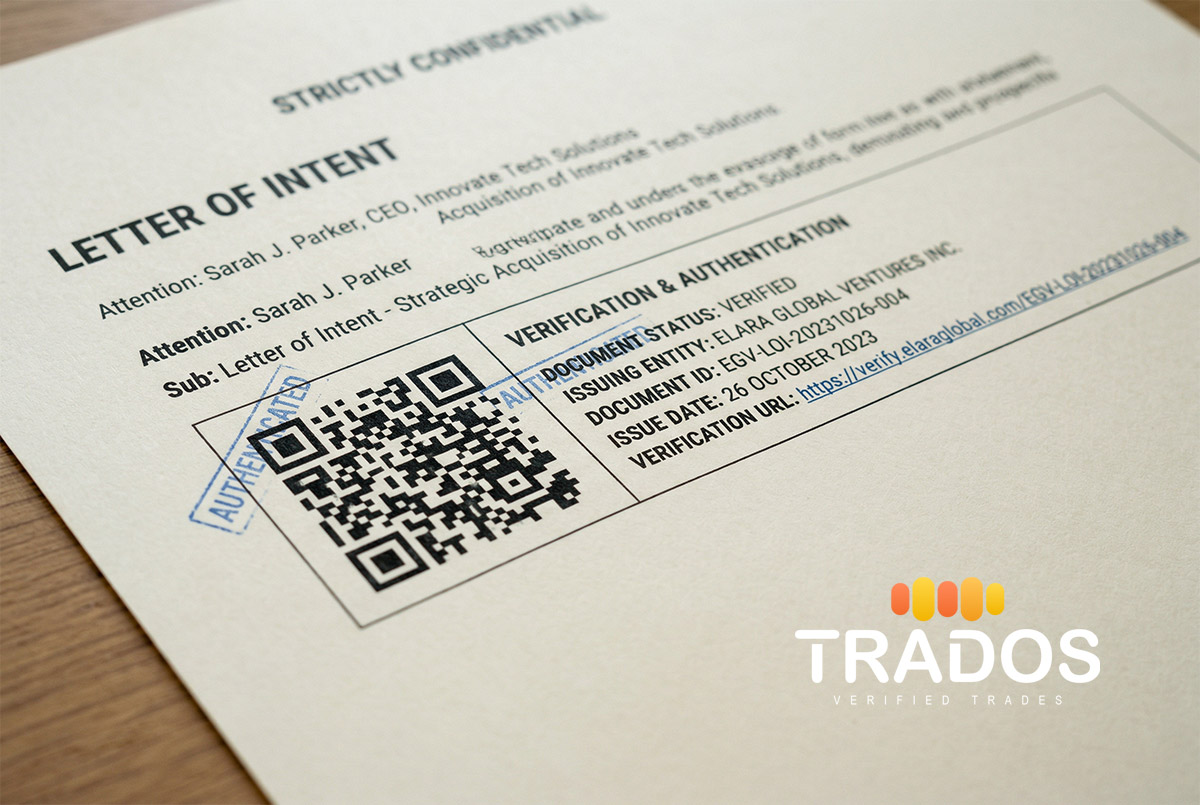
A small square of black and white pixels. About the size of a postage stamp. Sitting in the corner of an LOI document, next to a shield logo. This directly impacts how QR code commodity trading performs in real-world trading scenarios.
Most people wouldn’t look twice at it. They might scan it out of curiosity. They might ignore it entirely. They have no idea that this little square represents a fundamental shift in how commodity trading works.
That QR code is the difference between weeks of uncertainty and 30 seconds of confidence. Between blind trust and verified proof. Between the old way of trading and the new.
The Problem with Paper
For centuries, commodity trading relied on paper. Letters. Contracts. Certificates. Documents that traveled by mail, courier, and eventually email and PDF.
The problem with paper is that it can’t prove itself. When you receive an LOI, you’re holding a claim—a statement that someone wants to do business with you. But the paper (or PDF) doesn’t tell you if that claim is true.
Is the company real? The paper says so, but anyone can type a company name. Experienced professionals in QR code commodity trading consistently emphasize this point.
Is the person authorized to sign? The signature looks professional, but signatures can be forged.
Are the terms legitimate? They seem reasonable, but you won’t know until you verify.
Paper creates a trust problem. And trust takes time to build—weeks of phone calls, reference checks, and due diligence. Time that kills deals.
The Digital Promise (And Its Failure): QR Code Commodity Trading Essentials
The internet promised to solve this. Digital documents. Instant communication. Online verification.
But the reality fell short. Digital documents were easier to fake than paper. Email addresses could be spoofed. Websites could be cloned. PDFs could be manipulated. When evaluating QR code commodity trading, this factor plays a significant role.
The digital age made document fraud easier, not harder. Scammers flourished. Trust became harder to establish, not easier.
What the industry needed was a way to link documents to verifiable truth. A way to connect the paper (or PDF) to proof that couldn’t be faked.
That’s where the QR code comes in.
How the Trados QR Code Works
The Trados QR code isn’t just a link to a website. It’s a cryptographic key that unlocks verified proof.
Here’s what happens when a QR code is created: This is a critical aspect of QR code commodity trading that every trader should understand.
1. An LOI is uploaded to Trados
2. The platform conducts comprehensive verification
3. Verification results are stored on secure servers
4. A unique cryptographic signature is generated
5. That signature is encoded into a QR code
6. The QR code is embedded into the certified LOI
Here’s what happens when the QR code is scanned:
1. The scanner reads the cryptographic signature
2. The signature is verified against Trados servers
3. If valid, the verification results are retrieved
4. The recipient sees complete certification information
5. The recipient knows instantly that the LOI is legitimate
The result: A direct link between the document in your hand and verified truth on secure servers. Proof that travels with the document.
Why QR Codes (And Not Something Else)?
QR codes might seem like an odd choice for high-stakes commodity trading. Why not blockchain? Why not digital signatures? Why not something more sophisticated? This best practice for QR code commodity trading has been validated across leading trading firms.
Because QR codes work. They’re:
Universal: Every smartphone can scan them. No special apps. No proprietary hardware. No learning curve.
Fast: Scan to verification in under 10 seconds. No waiting. No processing delays.
Secure: The cryptographic signature can’t be duplicated. Fake QR codes either don’t work or show as invalid.
Simple: No technical knowledge required. Point. Scan. Verify. Anyone can do it. Top trading firms leverage this insight as part of their QR code commodity trading approach.
Portable: The QR code travels with the document. Forward the PDF, and the verification travels with it.
Sophisticated technology is worthless if people can’t use it. QR codes bridge the gap between advanced verification and practical usability.
The Scanning Experience
What actually happens when someone scans a Trados QR code?
Step 1: Scan
Point your phone camera at the QR code. The camera recognizes it automatically. A notification appears with a link.
Step 2: Access
Tap the link. The Trados verification page loads. No login required. No forms to fill out. Instant access. Getting this right is fundamental to any successful QR code commodity trading strategy.
Step 3: Verify
The page displays:
– A large green checkmark (or red X if invalid)
– The certification status
– The counterparty’s verified information
– The certification timestamp
– The document fingerprint
Step 4: Trust
You now know, with certainty, whether this LOI is legitimate. The verification gap disappears. You can proceed with confidence—or walk away knowing you avoided a scam.
Total time: Under 30 seconds from scan to certainty.
What the QR Code Proves
The Trados QR code isn’t just a link—it’s proof of multiple verifications:
Document Authenticity: The QR code proves this specific document has been analyzed and certified. It’s not a copy, a forgery, or a manipulation. The relationship between this and QR code commodity trading is well-documented in the industry.
Counterparty Verification: The linked verification page confirms the counterparty’s identity, corporate standing, and authority to sign.
Fraud Screening: The certification indicates the LOI has been screened against known scam patterns and passed.
Compliance Status: The verification includes regulatory compliance checks relevant to the transaction.
Timestamp Proof: The certification date proves when verification occurred, preventing replay attacks with old certifications.
One scan. Complete proof. For firms focused on QR code commodity trading, this should be a top priority.
The Fraud Prevention Power
The QR code’s most powerful feature isn’t verification—it’s fraud prevention.
Scammers can’t fake it: The cryptographic signature is unique and server-verified. A fake QR code either won’t scan or will show as invalid.
Scammers avoid it: When traders require certified LOIs with QR codes, scammers move on to easier targets. They’re looking for victims who don’t verify.
Scammers get exposed: If a scammer tries to copy a legitimate QR code onto a fake document, the verification page will show a mismatch. The fraud is immediately obvious.
The QR code creates a verification ecosystem where fraud is difficult and detection is instant. Industry experts agree that QR code commodity trading effectiveness depends heavily on this factor.
Real-World Impact
The QR code sounds simple. Its impact is profound.
For LOI Senders:
– Response rates triple because recipients can verify instantly
– Trust is established before the conversation starts
– Deals progress faster because verification is already done
– Professional reputation improves because certification signals competence
For LOI Receivers:
– Verification time drops from weeks to 30 seconds
– Fraud exposure drops to near-zero
– Decision-making improves because information is complete
– Confidence increases because proof is verifiable
For the Industry:
– The 68% LOI failure rate begins to drop
– Trust is rebuilt through verifiable proof
– Trading speed increases to match market demands
– Fraud becomes economically unviable for scammers
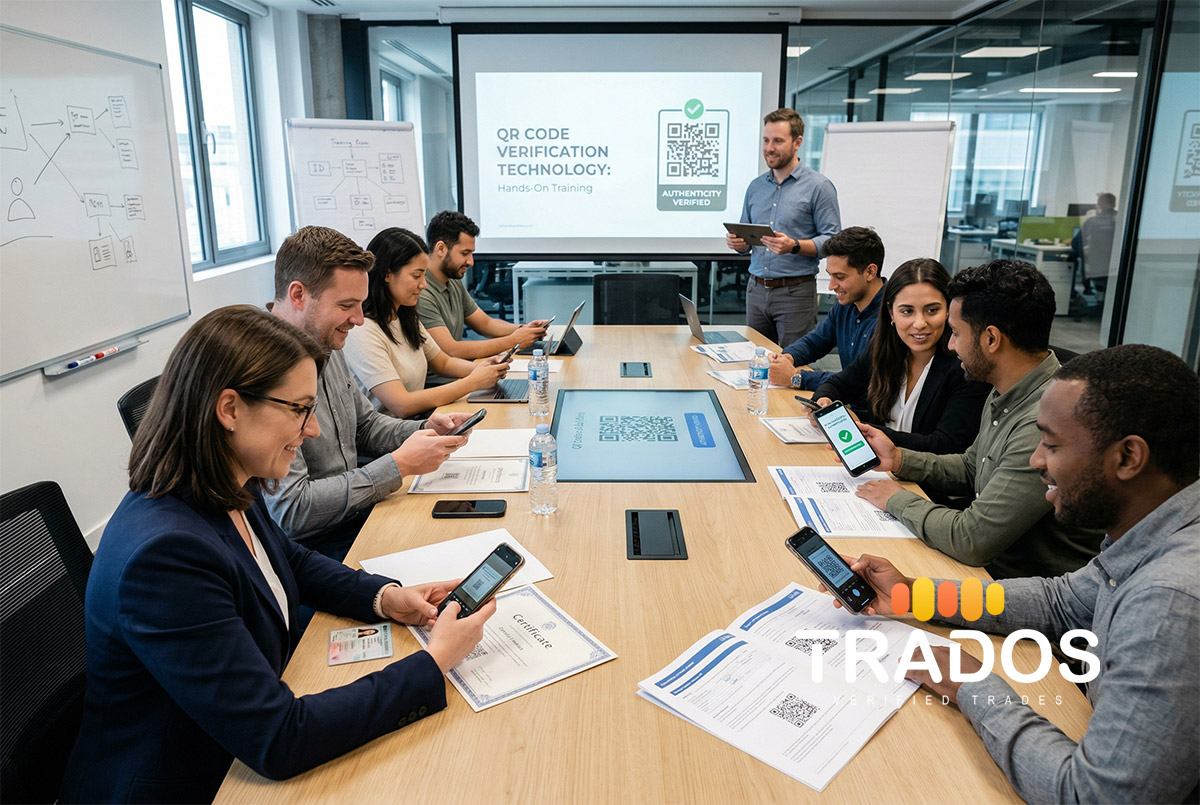
The Psychology of the Scan
There’s something powerful about the physical act of scanning a QR code. This principle applies broadly across all aspects of QR code commodity trading in commodity markets.
It’s active: You take action to verify. You’re not passively accepting information—you’re actively confirming it.
It’s tangible: The scan produces a result. A green checkmark. A verification page. Proof you can see and save.
It’s fast: The instant result creates confidence. No waiting. No wondering. Immediate certainty.
It’s shareable: You can show the verification page to colleagues. You can save it for records. The proof is portable.
The QR code transforms verification from an abstract process into a concrete action with visible results. Understanding this connection to QR code commodity trading gives traders a measurable advantage.
Adoption Patterns
QR code verification is following a familiar technology adoption pattern:
Early Adopters (Now): Trading firms who embrace certification gain competitive advantage. They close deals faster and avoid fraud more effectively.
Early Majority (Next 12-18 months): As certification proves its value, more traders adopt it. It becomes a standard expectation in professional trading.
Late Majority (2-3 years): Certification becomes the norm. Uncertified LOIs are viewed with suspicion. The QR code is expected on every document.
Laggards (3+ years): Those who don’t adopt certification find themselves at a competitive disadvantage. They struggle to close deals in a market that demands verification. This directly impacts how QR code commodity trading performs in real-world trading scenarios.
We’re in the early adopter phase now. The opportunity is significant.
Beyond LOIs: The QR Code Ecosystem
While LOIs are the starting point, the QR code verification system extends further:
Contracts: Certified contracts with embedded verification
Certificates of Origin: Verified documentation of product source
Inspection Reports: Certified quality and quantity verification
Shipping Documents: Verified logistics documentation
Payment Instructions: Certified banking details to prevent wire fraud
The QR code creates a web of verifiable trust throughout the trading lifecycle.
The Simple Innovation
The Trados QR code isn’t revolutionary technology. QR codes have been around for decades. Verification databases aren’t new. Cryptographic signatures are well-established.
The innovation is in the application. Taking these existing technologies and applying them to solve a specific, costly problem in commodity trading.
Sometimes the most powerful innovations aren’t the most complex—they’re the ones that solve real problems simply and effectively.
Conclusion
That little square of black and white pixels represents something big.
It represents the end of verification delays that kill deals. It represents the end of fraud that costs millions. It represents the end of blind trust in an industry that demands proof.
One QR code. Instant verification. Complete confidence.
The QR code changed commodity trading not because it’s complex, but because it works. It connects documents to truth. It enables verification at the speed of business. It makes fraud difficult and detection instant.
The traders who adopt it first will gain the

Related Articles
Learn more about UNCTAD commodity reports.



The technology section is good but could go deeper on API integration. Many trading firms use custom ERP systems that need to connect with verification platforms.
We implemented some of these practices at our firm last quarter and the results have been remarkable. Thanks for putting this together.
Couldn’t agree more with this.
Solid insights as always.
Can you elaborate on the digital signature verification part? We’ve been using a manual process and I’m not sure how to transition.
After reading this, I immediately audited our current LOI process. Found three gaps we need to address. Thank you.
Great article, thanks for sharing.
This saved me a lot of headaches.
Our legal team reviewed this and they were impressed with the accuracy. Not something you see often in online trading content.
Great overview. Do you have any recommendations for firms that are just starting to implement verification processes? We’re a small operation with limited resources.